It’s been over fifty years since The Godfather premiered in theaters, and Robert DeNiro gave an Oscar worthy performance in The Godfather Part II, for his role as Vito Corleone. Almost twenty years later, fans of mafia films received another “would be” classic, Goodfellas in 1990, becoming a favorite, along with its director Martin Scorsese, among Generation X and Millennials. One consensus among classic, mafia films, is their male hero(s) at the helm, and male toxicity propelling the stories.
Not that viewers are eager to see women in the criminal sense, it is a sexist perspective to assume that women are incapable of committing crimes of the mafia sort, are less appealing in those roles, and/or an audience would dislike a mafia film with a female mobster in the lead role or a female dominated cast of characters, which is insinuated when male leads have an overwhelming dominance in the subgenre.
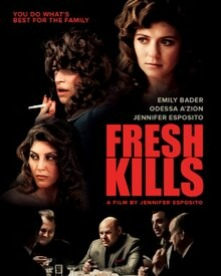
Speaking of female-led mafia films, I recently saw Fresh Kills, starring Jennifer Esposito, Emily Bader, and Odessa A’ zion. This film is reminiscent of a Martin Scorsese film, with the exception of a female-centered story. In no way am I undercutting director Jennifer Esposito’s directing style, but at the risk of being presumptuous, his influence is present: the movie has a voice-over narrator, NY setting, and even a two-hour running time that moviegoers are accustomed to with Scorsese films.

Jennifer Esposito, as a director, pulls great performances out of her two screen daughters: Rose, and older sister, Connie. She has the acumen of a director with twenty years of experience, you can probably attribute to her acting career. As a director, she doesn’t always rely on dialogue to inform the audience, nor does she have her young women crying excessively when faced with adversity, which is a lazy, go-to move, too often used by male directors. She shows the different layers of her characters in realistic ways.
This film’s story arc is dominated by the female characters but don’t overlook Dominick Lombardozzi’s superb performance. He plays the family’s patriarch, Joe Larusso. His subtle performance as a mafia don works. Viewers are known to like their mafiaso characters depicted in a brash and overt way. In his portrayal, the moments where Larusso speaks no words, show him as a boss the most. It’s not always the guns, verbage, and violence, but the walk of a don, his smirk when he’s in handcuffs, his cocky pose in a courtroom; usually those in power have a quiet authority and–if they are smart–they choose a less conspicuous profile. Lombardozzi embodies the persona of a Paul Castellano archetype.
Fresh Kills tells the story of a mother, raising two daughters, with her mafia don husband in Long Island, NY. The tale begins in the late eighties then fast forwards to 1993. The Larusso’s appear to be the average, American, middle class family, with the exception of their mafia affiliation. However, as the girls get older, they get wise to their father’s mafia title and the loyalty their parents expect from them. Connie alludes to wholehearted loyalty while Rose is in evocative conflict with this expectation.
Thirty minutes into the film, I began asking myself whether it’s time to find another movie to watch; I was growing bored. At first, it felt like the camera lens was wandering, trying to catch entertainment as it happened. Then the story started to pick up. I could see where it was going. The story lacked focus until we see the dynamic between the sisters, as they entered their twenties. Rose and Connie grew into two different women, with distinct moral compasses, which made their domestic life and family wars vivid and tumultuous. The lesson Connie tries to teach Rose is the lesson she failed to learn herself.
This is not a typical mafia tale in that it focuses on female relationships between the mother and her daughters, and the “seemingly” loyal sister against the sister struggling with her identity within a family whose convictions don’t align with hers’. These relationships and the mafia ties that bind them, display a struggle so complex that it stifles a young woman’s identity.
Rose is the character whose development gets the most attention, pertaining to the writers room. Throughout the film, she is dragged around by her controlling sister, who is more vocal and somewhat of a badass. Though Connie has secrets of her own, and struggles with her identity, she is better at disguising her insecurities and disloyalty. Meanwhile, Rose doesn’t know how to tell the man she has been dating for years that she is not interested in the traditional trajectory expected of a woman and needs time for self-discovery.
Older sister Connie should not be idolized; we learn her identity, and fate, in the end. Until then, she portrays a front of confidence and control under pressure that Rose admires. Connie is the woman of two faces. She upheld a facade that even her own family believed. It also shows how the mafia lifestyle can destroy a family–not only by external forces, such as law enforcement, politicians, and legislation–but from the inside.
In the moments when the film focuses on too many relationships and dynamics, it is uninteresting, but when it zeroes in on the sisters, it has the potential to be in conversation with classics from the mafia subgenre. I would recommend this film, especially if you like mafia films but are tired of the same old vices glorified in the male-dominated stories.
 Junkie 4 A Story